This is a little bit of a layman's question but maybe someone is interested:
When people go searching for prime numbers / bitcoin with massive compute, I assume that there are huge libraries of "shortcuts" to reduce the searching space, like prime numbers only appear with certain patterns, or there are large "holes" in the number space that do not need to be searched, etc. (see videos e.g. about how prime numbers make spirals on the polar coord. system, etc). I.e. if you know these you can accelerate/reduce your search cost by orders of magnitude.
For whatever various encryption algorithm that people choose to test or attack (like this story), is there somewhere such libraries of "shortcuts" are kept and well known? To reduce the brute force search need?
And is the state of sharing these to the point that the encryption services are designed to avoid the shortcut vulnerabilities?
There exist certain classes of prime numbers that should not be used for some cryptographic operations because algorithms exist that reduce the computation required for factoring attacks. This more often applies to cases where smaller primes are applied. Sources for this king of knowledge are mathematics or cryptography textbooks.
For other cryptographic operations, almost any sufficiently large prime can be used. Even a 50% reduction on a computation that will take trillions of years, has no practical impact.
That's not really how it works. There aren't any noticeable patterns in prime numbers (besides trivial ones like they are all odd numbers) and they remain dense (no big gaps) even for very large numbers like what are used in RSA. The best algorithm for generating prime numbers is to just pick a really big random odd number and then test if it is prime, repeat until you find one.
Now, factoring large numbers is a separate thing. You don't brute force all the possible factors, that would be a really bad approach. Modern algorithms are called "sieves," this is a gross oversimplification but essentially they keep picking random numbers and computing relations between them until they come up with enough that have a certain property that you can combine them together to find one of the factors. It doesn't have anything to do with shortcuts or patterns or tricks, it is just a fundamental number theory algorithm.
-- making the cost of employing a good staffing level of police more affordable (so that we can have more, everyday police doing a job as a neighborhood force and seen as a reliable presence against crime)
-- more certain prosecution and penalties for quality of life crimes that we all pay for in seeing petty but significantly confidence-decreasing incidents that reduce our willingness to take public transport
-- reducing the cost / increasing the frequency and usefulness of public transport services where you regard it equally as convenient as private vehicles
You go to some other countries (less rich ones particularly) and buses have 2 crew, trains have multiple staff, taking fares, making sure rules are obeyed. Giving people confidence that this is something they want to ride on. Not a system where it looks like the station is half abandoned, was last cleaned about 2 years ago, and if you were mugged or even just reported a crazy ranting homeless person, they would shrug and tell you to phone it in.
New York has an extraordinary level of police already. They're just bad at dealing with the actual problems. Including murdering a bystander in a totally unnecessary subway shooting.
Are there are cameras inside the zone tracking cars to bill them if you are already in the zone, or if cameras only track entry to the zone? (i.e. cameras only on the border). If someone happens to evade the cameras, do they catch them eventually just by traveling within the zone? I believe London for example has internal zone cameras.
The purpose being, first of all, to ensure that people do not somehow evade paying just by operating solely within the zone, defeating the purpose of reducing traffic. And secondly, to stop people from engaging in loophole seeking behavior.
I hope that loopholes and people defrauding the system (license plate obscuration, etc) are quickly caught and penalized. You would hope that if a car enters or is detected with invalid plates, it triggers an automatic report to police nearby to follow up. Otherwise, like so many things (it seems now) we just throw our hands up at people who evade the rules and charge those who follow them. (my comment spurred by an NYT article about how people might scam the system)
The number of people who entirely live and work and drive inside the zone is going to be vanishingly small in comparison to the people who transit the zone border so I'm not sure it's going to be that big of a deal.
I just wonder why they choose not to enforce this aspect of it when it can be a significant population (in a statistical sense) of the car traffic as well as revenue. Manhattan inside the highways is a big place.
Maybe it's the cost of the cameras to be installed.
> I just wonder why they choose not to enforce this aspect of it when it can be a significant population (in a statistical sense) of the car traffic as well as revenue.
It's not. 85% of Manhattan households don't own a car at all. The number is even higher inside the Congestion and Relief Zone. Almost all car traffic within the zone is from people who do not live within the zone.
Plus of that 15% that do own a car how many actually only use the car within the Congestion Zone a significant portion of the time? My guess is the number is well below 1% of car traffic could possibly dodge a significant portion of the toll.
> Plus of that 15% that do own a car how many actually only use the car within the Congestion Zone a significant portion of the time? My guess is the number is well below 1% of car traffic could possibly dodge a significant portion of the toll.
There's no real way to get reliable numbers on this, but I would estimate that >70% of people who live in the Congestion Relief Zone and own a car use it primarily as a way to access their second home in the Hudson Valley.
I would have said that in 2019, but the testimony from congestion pricing opponents during the multiple rounds of public hearings that we've had since then only further corroborate that impression.
I wager they did a study to weigh the costs and came up with the inevitable answer that chasing down the tenth of a percent (a wild guess but I think it's at worst an order of magnitude off from the actual number) of cars that exist only within the congestion zone and never leave would cost more than you'd gain both in fees and second order effects. Especially the population of cars most likely to never or rarely leave are being charged on a per ride basis, cabs and rideshare vehicles like Uber etc.
It's like all the efforts to drug test people on welfare, they cost vastly more than they save/recover.
I don't see what good it would do to have a car that can only travel in lower Manhattan. Yeah the few people who live there, own a car, and are lazy or use it for going to get groceries 2x a week might slip through, but that's nothing significant in my book.
What would worry me is if it leads to more license plate theft. Criminals get to ride for free, while legally registered owners have to fight the fines and clear their name in NYCs byzantine government.
If you had a friend or SO, one could drop off the other, then circle around a while and pick them up later. But that further reinforces my point that there's little to gain from "cheating" this way.
It is already big a deal to change the images on currency (no matter what country). Given the US dollar is viewed as somewhat of a standard, you can imagine that to change its size/shape would be quite difficult to generate enough political enthusiasm for.
I personally far prefer the cotton paper money over any polymer notes or coins and hope we keep using it despite any other potential changes to the sizes or designs or whatever.
I think it is a nice material that is highly robust, tolerates creases and heat significantly better, and feels much nicer. I don't really understand why anyone would prefer polymer notes.
I wish it was the reverse. I’d prefer to have the smallest denominations within easiest reach by being the biggest and the largest denoms tucked away and hard to get to.
But retailers would protest I’m sure: it’s not the psychology they want.
There is one private company that either directly manufactures or leases the machines out to produce every polymer banknote in the world. In theory Romania already has 80% of what they need to produce Australian bank notes and vice versa.
There isn't anything other than US bills you can use to get the raw materials for US currency.
All you need is the cotton blend of paper. There's no secret ingredient. Either find a paper pulp manufacturer who sells the blend like this guy from Quebec or build your own processes like North Korea. Many developing world currencies are more secure than the USD.
The printed design has remained the same but the form factor has been pretty static for the last century or so. Things like bill readers are a big reason for that once they appeared it became a lot harder to swap around bill shapes.
I remember hearing that the Susan B Anthony dollar coin failed because there was no extra position in the coin drawer of cash registers to put it in. Can you image if every cash drawer now has to be redesigned to have different sized bills?
(I know, I know, it's not actually that big a deal. The drawers have removable inserts, but you get the point of it.)
(actually, on second though, automatic bill readers in vending machines, etc. would need a big retrofitting, that's probably much more a big deal).
The cash register issue I think could be papered over by just having the bills be smaller than the existing bills, ie $100s stay the same size and we cut off a bit of the bill for each denomination step downwards. That would keep them fitting in the drawer and be in line with the pattern of other countries who also make larger denominations physically larger.
1971 wasn't such a big deal. Between the 1930s and 1971 only foreign central banks could redeem their dollars in gold. So I would put the 'partial default' in 1933, if you care about gold.
But they had suspended convertibility of dollars into gold every so often before that. (And, of course, the dollar wasn't always about gold. They also experimented with silver and bimetalism.)
> But they had suspended convertibility of dollars into gold every so often before that.
They suspended redemptions of the certificated amount. You could not own gold until 1933 from 1974, but excluding of that, you can always convert your money into gold outside of the government if you want.
It’s a feature (or bug)of US democracy that one of its primary values, its reason for existing, is to support individuals and their freedom. Individuals are the values.
And people seem to forget that the U.S. is not a pure democracy. It's a democratic republic that is becoming more and more republic-like than democratic-like.
Since the founding we’ve changed to direct elections in the senate.
Many states have passed faithless elector laws for the electoral college and 17 states (or 209 electoral votes) have passed the national popular vote law.
The U.S. is controlled by an ever shrinking collection of people and institutions, namely corporations and extremist groups. That's how it's more and more republic-like.
Sure, you could even bring a national voting system, but it wouldn't make it any less of a republic because of the outsized influence that the sub one percent of people have.
Are you saying that you believe our judicial system is fair and impartial only when it rules in your favor?
I vaguely recall a similar sentiment: "the system is been rigged because I didn't win!"
Courts rule on laws. If you don't like the laws, go and seek to change them. Don't cast suspicion on our judicial system, one of the reputable institutions that takes the time and effort to study facts and uphold our rights when we need them the most, because it didn't go your way on a topic of net neutrality. NN is hardly a long settled human right that you can declare it an injustice if the US turns out not to apply it in a certain way, and you're turning a ruling on whether the FCC is the proper mechanism for regulation into "the system is corrupted".
Consider applying principles of government that don't shoot yourself in the foot if the other side takes power. It's one of the few things that sets us apart from less civilized countries.
"Multivariate analysis indicates that economic elites and organized groups representing business interests have substantial independent impacts on U.S. government policy, while average citizens and mass-based interest groups have little or no independent influence. The results provide substantial support for theories of Economic-Elite Domination and for theories of Biased Pluralism, but not for theories of Majoritarian Electoral Democracy or Majoritarian Pluralism."[1]
Yes, of course what you quote is true -- more resources favors large entities and corporations. Similarly for example, the rich versus poor when appearing before the legal system. That is a deep problem of democracy + capitalism.
But if the desire is to reduce the influence of money in politics and the weight of corporations in our lives, that is something for Congress and our laws to be modified to do. Similarly to decide to tax, redistribute, or equalize the playing field between rich or poor. You would not have a court decide what tax policy to enact, or what the thresholds of welfare or social security brackets are. Courts are to resolve concrete disputes between individual parties using principles derived from the law, not promulgate new laws.
Courts have to treat people and entities coming before them in cases as equal parties, based on their arguments and evidence. If the side of corporations have more resources to pursue cases, hire lawyers, and fabricate evidence, etc. than individuals, then that's something for Congress and laws to fix. Courts are not here to somehow say that when there's a dispute, individual people's arguments take precedence over a corporation's when the law is clear about enumerated rights or regulations. Or to say a general policy principle like "people's rights trump corporations' rights". That is not a justiciable statement.
The relative rights of people versus corporations is where laws should lay out those definitions, in the places and applications where the theoretical becomes the real. Not for courts to create novel rights that are not subject to the democratic process and checks/balances on such important questions. Or if they're not specified in the Constitution.
A lot of the framers (if you're going to be a pedant, use the right words) knew that "mob rules" had troublesome implications with respect to the humans they claimed ownership of.
Not always. They invent laws. They defy laws. They defy common sense. For example "qualified immunity" is invented out of thin air, while "the spirit of Aloha says US Constitution does not apply to Hawai" is defiance. "boneless chicken does not mean it has no bones, but it is a style of cooking" is totally nuts. All the examples are Supreme Courts cases.
This is not about winning or losing, it is about judicial system not fair and not impartial, sometimes borderline crazy.
I'm not sure how you came to this conclusion, when their comment stated in the very first line: "court rulings that rarely appear to be in favor of people over companies".
But answering your strawman: when you have a bipartisan system with both parties led by companies I don't really have a clue how one can seek to change companies-favoring status quo/laws, but I'm willing to be educated - please help.
Perhaps supernova87a thinks the court system is doing a great and highly professional job of enforcing a bad set of laws handed to them by an failing legislature?
Much like a professional painter and decorator can demonstrate great care, precision and craftsmanship in applying the paint, even if the customer chose an ugly-ass colour.
Thanks for your comment, and this is a reply to others who have replied.
I wouldn't go so far as to say the courts are doing a great job. But they are doing their job to interpret the laws that have been written. Far more conscientiously than the political branches. Interpretations of the law are yes, sometimes interpretations that may favor one side over another, because laws are not always clear down to the very last edge case or issue that was not anticipated at their writing, and high level principles (sometimes laws have to be at this level) can be interpreted different ways. If that were not true, then you would hardly need a judiciary. That is their role.
But to say that the judicial system has been corrupted and is biased, only because in recent years has made more rulings against "my side" when the issue is not clear cut, is to undermine one of the institutions that takes its job relatively seriously. If we adopt this perspective, why are Republican/MAGA opinions that the judicial system is corrupt because they got ruled against so many times, not equally legitimate? Who is to decide that your saying the system is biased is more worthy than theirs?
How can we sustain a system where if the rulings go my way, then the system = trustworthy? A key distinguishing aspect of an advanced democratic society (cf. January 2022) is the acceptance of rulings and elections that don't go your way. And that courts rule based on law.
Many of the things that laws were originally written for are not covering the situations that are arising now. If you want to make the outcome different, go and change the laws and make it clear what the rules should be. Update them for technology developments, for changes in societal expectations. There is a mechanism for that. And the judiciary will have to adhere to the laws and Constitution to rule on them.
Courts are not equipped to be legislative bodies, and if you put that expectation on them, you are changing their scope and role. And not for the better. Judges will get elected for their favoring of one side over another, or to be writing laws while ruling on cases. That's not something I want our democracy or separation of powers system to start doing.
And if Congress is broken, that reflects the troubling divisions we have in society -- no court will be able to fix that (without actually corrupting what the courts are for).
You can look at opinions on recent rulings by their peers and determine they use motivated reasoning in their ruling to achieve the desired political outcome.
I'm not condoning some of that in recent rulings. But also ask yourself, is this the first time you noticed it, and that wasn't happening for rulings over the past 20 years for cases where you happened to agree with the outcome? Only sudden interest in applying that principle now, I guess?
> But answering your strawman: when you have a bipartisan system with both parties led by companies […]
One of the parties in the US has been pushing for net neutrality[1][2] and another has been getting rid of it.[3]
If you think the two parties are equivalent (on a variety of topics [4][5][6][7]), I'm not sure where you are getting your information from, but it is not accurate.
Thank you for the links! Then I don't understand something: if this one party supported some topic, any topic, how come said topic is not made into law but only lives in the internal regulations of some organization? Courts applying existing law will then by necessity strike those down, by definition: if it's not in the law it will not be recognized by the courts. Simple. So the whole complaining "court strikes down something" is pointless, because the courts function as designed. I'd say the problem is the parties which don't bother making supporting laws - yes even the parties claiming to support said topic. How can a party holding majorities (in a two party system one party will always have majority) even temporary, not actually make laws? Isn't this the very reason parties exist? So I'm still confused.
People (judges) sometimes go into court with an pre-conceived notion of what is the 'correct' way to interpret things, and they think it is 'objective', but in fact has been shaped over time by (active) cultural forces:
The Chevron doctrine, which was recently overturned by the US supreme court, stated that US courts should defer to the regulations of US agencies such as the FCC. As I understand, under Chevron, functionally, the FCC's regulations on telecommunications were law to the courts and the corporations.
It seems to me that it's unreasonable to expect Congress itself to have informed, correct opinions on technically complex topics. There are a limited number of Congressmembers, most of whom are not technically skilled. Delegating regulation to domain experts who remain accountable to Congress seems like a reasonable solution. If Congress disagreed with the FCC's handling of the situation, couldn't they have made a law to overturn the FCC's decision or limit its authority?
Overturning Chevron is a victory for deregulation in general. As I understand, Congress could pass laws to explicitly reinstate the authority that the FCC previously held. However, pro-deregultion factions (I assume mostly Republicans, but I don't really know) now have a chance to block that, and even the supporters of NN have other fish to fry.
Essentially overturning Chevron curtailed the authority of regulatory agencies-- authority which Congress expected them to have, and could have restricted at any time--without going through Congress. Yes, it's the job of the court system to interpret laws. But when they change interpretations which other laws depend on, that's basically changing the laws themselves, isn't it?
> It seems to me that it's unreasonable to expect Congress itself to have informed, correct opinions on technically complex topics.
Actually, that is exactly my expectation of my representatives. They have the resources and connections to find experts and become reasonably versed in these topics so we should expect them to have informed correct opinions on complex topics or they shouldn't be in the job.
> They have the resources and connections to find experts and become reasonably versed in these topics so we should expect them to have informed correct opinions on complex topics or they shouldn't be in the job.
Do they have the time?
There are only so many hours in the day and week, and only so many things that are able to be done in ((sub-)sub-)committees in those hours. Further, legislators have to pass law on every conceivable topic, whereas agencies have a focus (FCC, FAA, FDA, Coast Guard, etc).
And if the situation changes the legislators may have to circle back and pass new bills/regulations and that may take a while given finite resources (time) and other priorities, so various industries may languish in sub-optimal environments due to outdated legislation.
That's the whole point of the agencies (and executive?): delegation to subject matter experts so legislators aren't mired in minutia and can perhaps look at the bigger picture.
In an ideal world, I agree. But Congress is made up of the most electable people, not the most competent people. I would rather they recognize that and delegate rather than trying to make laws about complex topics which can easily backfire, or just taking no action at all.
Okay thank you this answers fully my question. I guess one could make that "Chevron doctrine" into law, a one-time law, then we'd have the issue solved right? So not making laws for every single topic, just enshrine that FCC and others make "laws", then the courts would have to respect that. Of course unless they contradict other laws, thus the courts will still not run out of cases, but at least you'd have some more predictability. But if the whole system relies more on precedent cases instead of explicit laws, you can never reach that predictability (see Roe vs Wade)...
I don't know of any reason why they couldn't make the Chevron Doctrine law. However, I doubt that the Republican congressmembers will let it happen any time soon.
Disclaimer: I'm not very informed, I just did a little Googling and then summarized it as an exercise to try to reinforce my own understanding.
So the three powers system is broken? Almost "by design" one could say, although it seemed to have worked for a while, maybe when the level of sophistication was lower (but whose level?). Or maybe there was a time when the actors tried to use the system, not actively seeking tricks to abuse it?
Obviously the problem here is that the judicial branch still works too well, and need to be broken like the rest of the government.
Then and only then, when every branch of government at every level has so much friction that the offices themselves burn to the ground, will we be able to enjoy the freedom that God and the Founding Fathers intended.
If the government that governs least governs best, then the government that governs best doesn't govern at all.
In this video of the plane going along the runway, it just seems to me it's going very fast well into a no-gear landing. Like they didn't set it down for more than half the runway (and the runway was 9200 feet)
Fun to imagine on geophysical length scales that each dot of gold-sulfur rich complex in the diagram could represent like several orders of magnitude more gold than has ever been mined out of the Earth to date.
(No idea whether that is the right sizing, but I could totally imagine it being the case)
edit:
"...The estimated amount of gold ever mined is around 212,582 tonnes, according to the World Gold Council. This is roughly equivalent to a cube of gold that's about 22 meters on each side..."
Japanese companies and organizations (and people) love diagrams to present to the public. Whether how to navigate a website, book a ticket, check-in to a hotel, etc. the number of process diagrams in daily life (as a perceived effective way of communicating information) is unseen outside Japan.
Also, the amount of highly detailed posters in public places. For example, the departures board of a train line -- far more information than probably the average US rider knows how to comprehend even. Or is interested in.
Both are standard-looking maps, honestly - stem and leaf is so obvious I have problems imagining what other form you'd expect, and I have never seen japanese public transport timetable sign before now. It's just standard over here (Poland, UK).
The format of metro map is actually based on London metro, the only major difference is the amount of lines.
That first board is just a list of departure times by hour, with express trains highlighted. For weekdays and weekends. Not exactly a huge amount of information.
I'm more impressed by their maps of where each station exit leads to, or where on the platform to wait based on your seat number. Those can be tricky to figure out as there are multiple wait points based on the train route and number of carriages. Shinkansen even take into account what end of the carriage you're closest to.
Sooo yeah, I agree the Japanese one is much nicer. I don't recall ever even seeing a schedule at the stations, just "train arriving in X minutes". The train map and per-line map are at every station, and the train+bus map is pretty common too.
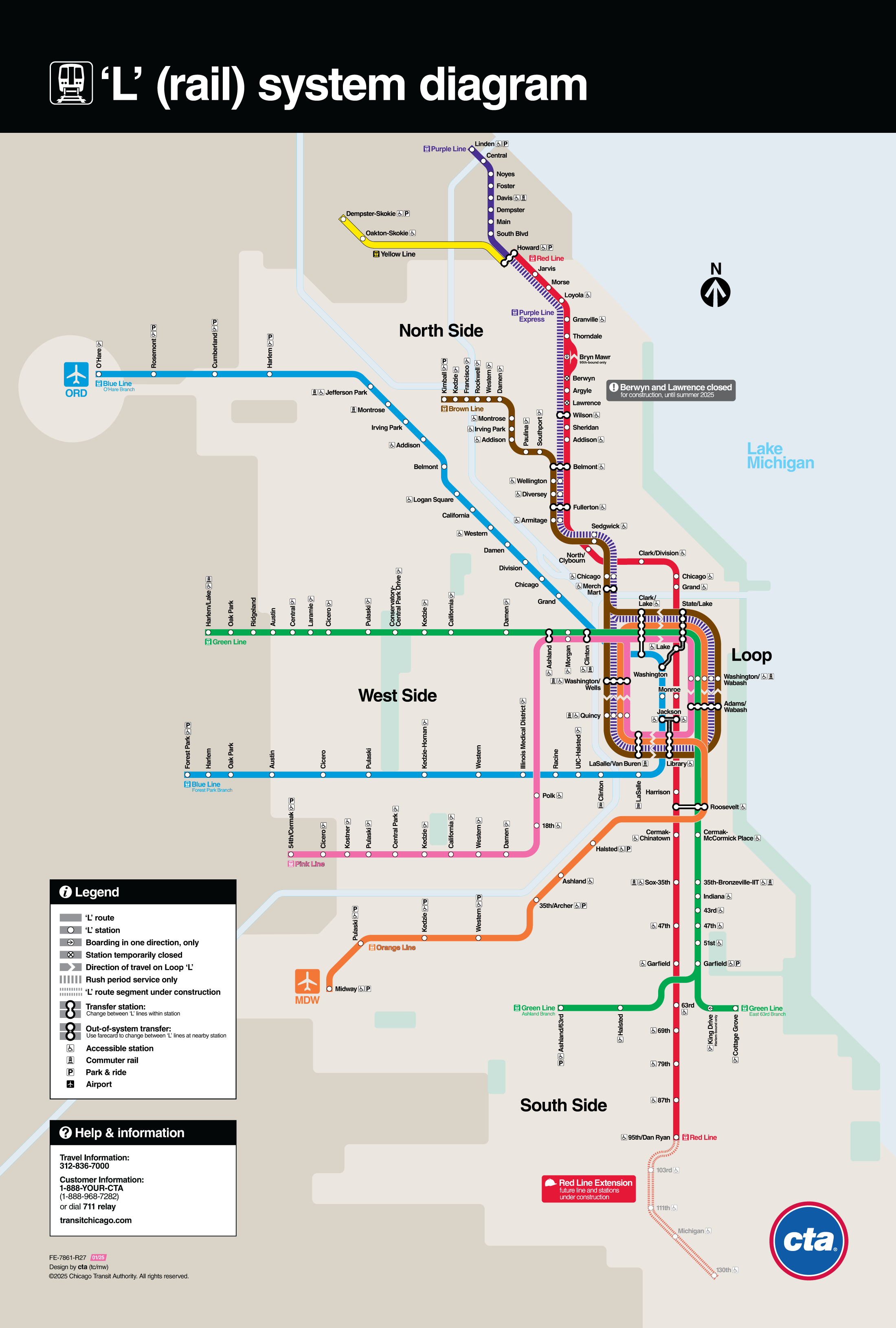
I notice the Chicago map has multiple stations with the same name -- is this not a problem when using Google Maps and other navigation apps? How would the app know which "Pulaski" I want to go to?
Those are the names of the street the station is at, if you follow the map north/south you'll see all the Pulaski stations are on the same street. In an app you'd use the address for where you want to go and it may or may not include the train. Though the apps can also understand "Blue line Pulaski" if it really is your destination rather than a stop on the way.
Employees are free to speak to each other about pay and work issues. Apple isn't obligated to help facilitate that over company-owned channels that are for work communications.
edit: I'm not going to delete this idea just because people who want a thing to go their way disagree with it. And it's not right that this opinion has been flagged.
This is the correct take. In the US, workers discussing issues like wages is a protected right (NLRB stuff). Nowhere does that imply a company has to act on that talk. That's up to the company.
However, it is quite clearly stated by the NLRB that the company cannot threaten or retaliate. In my former position, I had this come up twice, much to my surprise. In both cases, I advised the company of the employee's rights, then recommended a discussion to determine why the employee was dissatisfied. In both cases (though one was much more stubborn than the other), we ended up with favorable outcomes for both company and employee.
It can be done, but orgs the size of Apple are more likely to just buy the ability to do whatever they want, anyway. No fine will stop that behavior.
Did you read the decision? The company must provide some means of doing this. They’re allowed to say “ok email is for work only” but if they have a platform that is used for non-work communication then it must be able to host union and pay-related communication. Apple has one: Slack.
It might be good to follow your own advice and read legal judgements more carefully.
The company doesn't have to do anything. And certainly not actively provide employees with tools to engage in union organizing communications amongst themselves. That's laughable, I'm surprised you believe it.
The ruling is that companies can restrict employees from using the company's assets to communicate about union activities, if they have other means to do so. Employees generally have other means to do so. That is light years different from "the company must provide some means of doing this".
I don't know why you are so surprised given this decision actually overturns a previous one that basically ruled that not only must there be some means of this communication, but that the employer can't choose what it is (Purple Communications as mentioned in the post). So at one point the rules were actually stronger than they are now.
The decision requires that there must be some way for employees to communicate and organize among themselves. Generally courts take a dim view of things like "yes you could technically do it if you broke our policies to grab people's numbers and then started a Signal group". So I don't actually agree with your interpretation of what the ruling says that employers don't have to do anything. I will also note that, while unrelated, employers must provide employees with tools to organize in the physical space (e.g. by putting up posters in common areas). Your shock at the existence of these rules is unwarranted. I would definitely not use company resources to organize if I could avoid it just because it seems like a lot of trouble that is probably not worth it, but there definitely are protections around this kind of thing.
I'm not really going to spend any more time coming back here for discussion, as it has become uninteresting.
You're clearly an advocate for a side of the argument, not an objective analyst interested in finding out truth. And btw nothing "surprises" or "shocks" me, I have been watching this issue for quite a while and have some expertise in the matter.
You live in past rulings hoping that it means that your position is correct in the present. It is not, and that colors your analysis, which as a result isn't credible or interesting to discuss.
Discussions about pay and work issues ARE WORK RELATED COMMUNICATIONS. You had to say its work issues on the same sentence. Thats the law as well because it makes sense.
Just because you feel it is and you want it to be true, doesn't make it so. It's important to learn to separate advocacy of a position from your analysis of facts. Work-related communications are generally at the decision of the employer, not the employee.
You need to gain a more educated understanding of the law and what your rights are, and are not.
A right to do something does not extend to taking over someone else's means to do it. You are free to talk to someone in person about your wages. You are not free to use my equipment to do it. Or to bill me for your time spent discussing it. By your logic, a union organizer should be entitled to photocopy union organizing fliers on a company copy machine.
I am well educated on the subject. You just want me to side with the company not only against data that shows unions are beneficial to society in general but against my own self interest that would benefit me as an employee.
Notice that I would say that printing union fliers on company printers is fine to not allow, we can have different areas where we draw lines. I think sending an email to employees that a discussion is happening about union is fine. You seem to be on the camp of since the line can be drawn anywhere it should be drawn on the extreme that benefits the employer.
As if me asking Jenna over slack what her bonus was is incredibly taxing on the company for some reason. The only reason that you don't want this to happen over email or company slack/messaging is to prevent this communications to happen at all.
You seem a bit lost within your advocacy / desire for something to be true, and unable to discern fact from hope. You would be more credible if you could separate your wishes from what is the law.
I'm stating facts within the law. You are stating wishes, made unbelievably clear by your saying that I'm trying to get you to side against your data and interests.
Laws don't operate by saying that "unions are beneficial to society and to me" and so therefore it must mean that you're allowed to use other people's equipment to do what you want. Once you bring in that argument, it's clear you've lost.
I guess it's true: "don't argue facts against a man whose livelihood depends on ignoring them."
In the same way you aren’t obligated to spend your free time running around defending the world’s richest company’s quest to limit workers rights but yet here you are.
It's a non-sequitur though, since the complaints include Apple telling employees to take down social media posts and not to participate on online surveys.


.jpg)


When people go searching for prime numbers / bitcoin with massive compute, I assume that there are huge libraries of "shortcuts" to reduce the searching space, like prime numbers only appear with certain patterns, or there are large "holes" in the number space that do not need to be searched, etc. (see videos e.g. about how prime numbers make spirals on the polar coord. system, etc). I.e. if you know these you can accelerate/reduce your search cost by orders of magnitude.
For whatever various encryption algorithm that people choose to test or attack (like this story), is there somewhere such libraries of "shortcuts" are kept and well known? To reduce the brute force search need?
And is the state of sharing these to the point that the encryption services are designed to avoid the shortcut vulnerabilities?
Was always wondering this.